
About Me
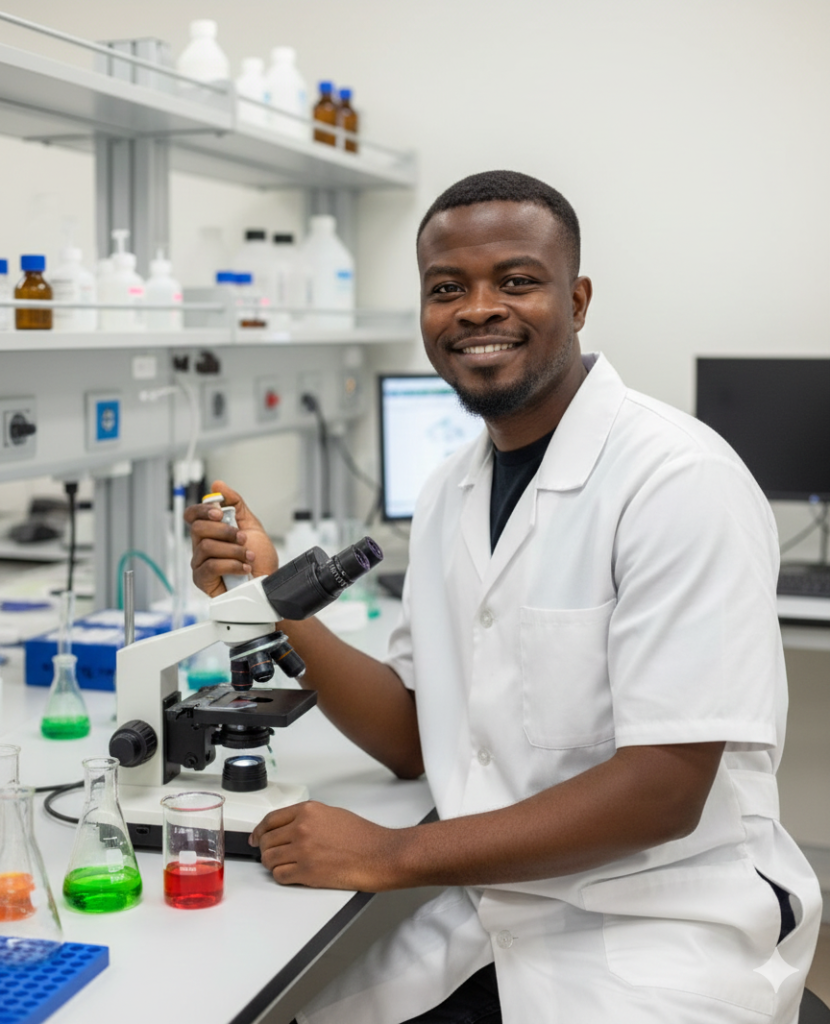
From an early age, I was fascinated by the hidden forces that shape our world—forces we cannot see, yet whose impact is everywhere. Growing up, I often wondered how the environment affects human health, why some communities experience unexplained health problems, and how science could help provide solutions. Those quiet curiosities slowly grew into a passion that has guided every step of my academic and professional journey.
Today, I work at the intersection of Medical Physics, Radiation Safety, and Radiochemistry, serving as a lecturer and researcher committed to advancing scientific knowledge that safeguards communities and enhances quality of life. My work explores radiation; both as a powerful medical tool and as an environmental factor that requires careful monitoring. I am driven by a simple but deeply rooted belief: science should serve people, and research should translate into better policies, safer environments, and improved health outcomes.
My academic path has taken me from Ghana to Russia and back again. Having studied a Diploma program in Environmental Health at the Accra School of Hygiene, I went ahead to study Bachelor of Science in Chemistry at the University of Energy and Natural Resources, after which I went to Russia to earned my Master of Science in Nuclear Science and Technology (specializing in Nuclear Medicine and Medical Physics) from Tomsk Polytechnic University, graduating with distinction.
Studying and conducting research in such different environments, both locally and internationally, have exposed me to diverse academic cultures, research methodologies, and problem-solving approaches that have strengthened my adaptability and broadened my professional outlook.
In Russia, I conducted experiments on biomaterials for medical applications, worked alongside nuclear medicine experts, and presented research at international scientific forums. I also trained in radiotherapy centers and research reactors—experiences that strengthened my skills in radiation detection, dosimetry, radioisotope handling, and medical physics practice. Every experiment and every presentation reinforced my commitment to using science as a tool for societal good.
Returning to Ghana, I brought with me both technical expertise and a renewed sense of purpose. As a Lecturer in Environmental Health Physics at the Accra School of Hygiene (which is affiliated to the University of Cape Coast in Ghana), I guide young scientists through hands-on laboratory work, research design, and scientific communication. I consider teaching not just a profession, but a form of mentorship—an opportunity to shape future leaders in health physics, nuclear science, and environmental research.
Beyond teaching, my work as an Environmental Health Officer has immersed me in real-world challenges. I have spent years monitoring radiation levels in communities, analyzing exposure risks, contributing to environmental research, and advising on safety protocols. These experiences remind me daily that science is not confined to laboratories; it lives in the decisions we make to protect public health and the environment.
I am also passionate about leadership and service. Throughout my journey, I have led scientific organizations, supported student research initiatives, facilitated international partnerships, and volunteered in community education and health programs. Whether mentoring young scientists, speaking at conferences, or engaging in community outreach, I strive to make science accessible, meaningful, and impactful.
In all these, my mission remains the same: To contribute research that enhances public well-being and ensures science is used responsibly in addressing medical, industrial, and environmental challenges.
When I am not in the lab or classroom, you’ll find me teaching, speaking at scientific gatherings, or engaging in research discussions, pursuits that continue to fuel my love for scientific discovery and knowledge-sharing.
My journey is still unfolding, but the goal remains constant:
to contribute to a safer, healthier world through rigorous science, thoughtful leadership, and lifelong learning.